

Best French Press For Everyday Use In 2026
🏆 Top Picks at a Glance
 #1
Best Overall
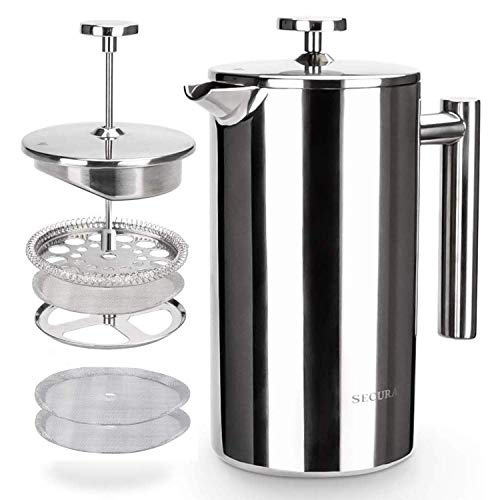
Secura French Press Coffee Maker, 304 Grade Stainless Steel Insulated Coffee Press with 2 Extra Screens, 34oz (1 Litre), Silver
$27.99
Check Price → #2
Also Consider
Veken 34oz French Press Coffee Maker, No Plastic Touching Cafe,1 L Cafetera
$26.99
Check Price →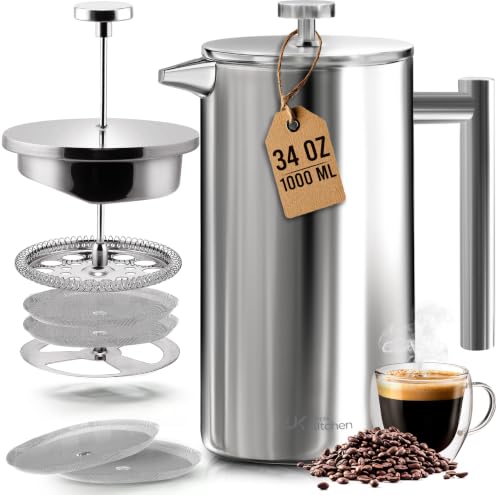 #3
Also Consider
Utopia Kitchen 304 Grade Stainless Steel French Press 34 Oz, Silver
$26.99
Check Price →Most people treat the French press like a lazy cousin of the pour-over, but if you want to move beyond muddy, inconsistent cups, you have to treat it as a dynamic extraction vessel. When you dial in your variables—aiming for that 1:15 ratio and a precise coarse grind—you can achieve an extraction yield between 19.2% and 22.1% that rivals much more complex brewers. This guide breaks down the best gear to help you master the physics of the plunge, from thermal stability to filtration precision. We’re looking past the pretty carafes to find the tools that actually deliver a balanced, professional-grade cup every morning.
⚡ Quick Answer: Best French Press
Best Overall: Secura French Press Coffee Maker
- Fit
- Considering Secura French Press Coffee Maker? Check the listed specifications against your requirements before choosing.
- Price
- $27.99
- Maintenance
- Follow the manufacturer’s use and storage directions for this product.
- Tradeoffs
- Extra screens may require manual assembly; Stainless steel body lacks glass transparency
Table of Contents
Main Points
- Prioritize thermal mass: Cheap borosilicate glass can lose more than 14°C in the first 90 seconds, dropping your slurry temperature below the optimal 92–96°C range and stalling flavor development.
- Focus on filtration fidelity: Look for presses with tight filter gap tolerances; a gap greater than 0.25mm can allow too many fines to pass through, resulting in a muddy cup and inconsistent TDS.
- Seek a bimodal grind distribution: Aim for a grind that provides 65% mid-size particles for steady diffusion and 20–25% fines to act as extraction accelerants for a creamy mouthfeel.
- Treat the plunger as a control switch: A quality press uses the plunger to apply roughly 8–12 kPa of downward force to separate solids, acting as a mechanical cutoff to terminate the extraction process.
- Lock your variables to diagnose flavor: The most effective workflow is to fix your ratio, grind, and temperature, then change only one variable at a time to troubleshoot issues like bitterness or hollowness.
Our Top Picks
Affiliate disclosure: if you buy through these links, we may earn a commission at no extra cost to you.
Factors to Consider
Frequently Asked Questions
How coarse should my coffee grind be for a French press?
You should aim for a precise coarse grind, ideally targeting a particle size distribution of D50 = 850–1,050 µm. This size helps maintain body while ensuring the mesh filter can effectively separate the grounds from the liquid.
What is the best water temperature for brewing?
According to SCA standards, the optimal water temperature for French press brewing is between 92–96°C. This temperature range helps facilitate the solubilization of sugars and acids during the immersion process.
sWhy does my French press coffee taste bitter?
Bitterness often comes from over-extraction or too many fines passing through the filter. If your plunger allows too many small particles through, they can increase bitterness and create a muddy texture.
What is a good coffee-to-water ratio to start with?
A common and effective starting point is a 1:15 ratio, such as using 30g of coffee for 450ml of water. From there, you can adjust your dose or grind to fine-tune the body and strength.
Can I use a French press for cold brew?
Yes, the French press is an excellent vessel for cold brew due to its immersion capabilities. Simply use a much coarser grind and a longer steep time to achieve a clean, concentrated extraction.
How do I prevent my coffee from tasting hollow or weak?
If your coffee tastes hollow, you may need to adjust your grind or increase your coffee dose. A bimodal grind distribution—with some finer particles acting as extraction accelerants—can also help improve mouthfeel and body.
Should I pour the coffee out immediately after plunging?
Yes, you should decant the brew immediately after the plunge. Because the coffee remains in contact with the grounds, continuing to leave it in the press can lead to over-extraction and a bitter cup.
Conclusion
Choosing the right gear means balancing thermal stability with precise filtration to hit those perfect extraction yields. For those seeking the best balance of temperature retention and build quality, the Secura French Press Coffee Maker, 304 Grade Stainless Steel Insulated Coffee Press with 2 Extra Screens, 34oz (1 Litre), Silver is our top recommendation for a professional-grade morning brew.


