

Best Coffee Scales With Precision Timers For Profe
Our Top Picks
Affiliate disclosure: if you buy through these links, we may earn a commission at no extra cost to you.

Factors to Consider
Accuracy and Resolution
⚡ Quick Answer
If you care about repeatable shots and tight dose control, aim for 0.1 g resolution with repeatability within ±0.1–0.2 g — that’s the difference between a consistent 18 g dose and a wandering one. Capacity matters too: a 2,000 g (2 kg) max is plenty for pour-over and bulk brews, while espresso-focused scales can get away with lower caps but must keep that 0.1 g step. Don’t be fooled by pretty displays that report 0.01 g but wobble under a portafilter; consistent, honest precision beats marketing decimals.
Table of Contents
Response Time and Stability
Speed of readout matters when you’re timing a shot or doing pulse pours — look for response times under ~200–300 ms and a stable reading that doesn’t bounce with every gram change. Anti-vibration feet, a rigid platform, and decent filtering electronics make a huge difference during fast pours and when you’re measuring yield vs. time. If your scale lags or hunts, your shot timing and flow-rate measurements become useless for dialing in extraction.
Platform Size, Shape, and Portafilter Compatibility
Think about what you’ll actually sit on the scale: for espresso you want a small, stable platform that accommodates a 58 mm (or 54 mm) portafilter without overhang; for pour-over or carafes, a larger, flat surface is essential. Platforms with low profiles and centered weighing areas reduce rocking and make tamping easier without changing the dose reading. Also check for non-slip pads and slightly recessed platforms so water and drips don’t shift your brew mid-extraction.
Timer Features and Integration
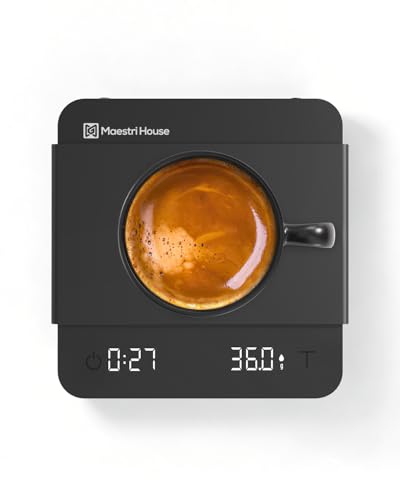
An integrated precision timer is non-negotiable for espresso lovers — look for shot clocks with start/stop buttons, programmable pre-infusion or auto-start via flow detection, and a clear split-time display. Bluetooth/app integration can log shots and show flow rate (g/s) and pour curves, which is invaluable if you’re chasing consistent extraction or dialing a new grinder, but it’s not required if the onboard timer is fast and accurate. Consider whether you want auto- tare or manual controls depending on whether you tamp on the scale or pull shots into a cup placed directly on it.
Build Quality, Power, and Price-to-Performance
Stainless-steel platforms, splash-resistant electronics (IPX ratings or at least good seals), and USB-C rechargeable batteries are the sweet spot for daily use. High-end scales cost more but repay you in durability, fast response, and reliable firmware — great for pros and committed home baristas; budget models are fine for casual pour-overs but often skimp on response and repeatability. Be honest about what you need: if you grind, dose, and time every shot, invest; if you only make drip coffee, a mid-range model will do the job.
Frequently Asked Questions
Do I really need 0.1 g accuracy for espresso?
Yes — for espresso a 0.1 g resolution is important because small dose changes significantly impact extraction and balance. A 1 g kitchen scale can hide variations that alter shot timing and yield, making consistent dialing nearly impossible.
Can I use a regular kitchen scale for pour-over?
For larger pour-over brews a standard kitchen scale with 1 g resolution is usually acceptable, since doses and yields are larger and small gram differences matter less. However, if you want precise recipes, flow-rate data, or are doing small-batch pours, a 0.1 g specialty scale is a better tool.
What does flow-rate measurement do and is it useful?
Flow-rate (g/s) tells you how quickly water is passing through the coffee — it helps diagnose channeling, grind setting, and pour technique during pour-over or espresso. It’s especially useful when paired with a timer and logging so you can compare pour curves between sessions and reproduce successful profiles.
Should I get a scale with Bluetooth and an app?
Bluetooth and apps are great if you want to log shots, visualize pour curves, and store recipes; they’re a valuable learning tool. But if you prefer a minimal setup, a fast, reliable onboard timer and clear display will serve you perfectly without the extra complexity or battery drain.
How do I calibrate my coffee scale?
Use manufacturer-recommended calibration weights (100 g or 200 g are common) and follow the on-screen or app instructions — do it on a flat, stable surface at room temperature. Calibrate periodically and after battery changes or sudden knocks; it keeps your dose and yield data honest.
Is a waterproof or splash-resistant scale necessary?
If you’re pulling shots or doing messy pour-overs, splash resistance is very handy because coffee and water are inevitable. Fully submersible scales are not common, but look for spill-resistant designs, sealed buttons, and wipe-clean stainless platforms to prolong life.
Where should I place the scale when pulling espresso?
Many baristas place a cup or shot glass on the scale under the group and zero/tare to capture yield directly, which is the cleanest way to measure extraction. If you plan to tamp on the scale, ensure it’s rated for that stress and has a rigid platform — otherwise tamp on a counter and weigh the puck or dose separately to avoid damaging the load cell.
Conclusion
Good scales are not glamorous, but they’re among the few tools that genuinely improve extraction and consistency every morning. For most specialty coffee lovers I recommend a rechargeable, 0.1 g scale with a fast, stable timer and a solid stainless platform — it’s the one upgrade that will make dialing shots and pours reliably repeatable without drama.


